
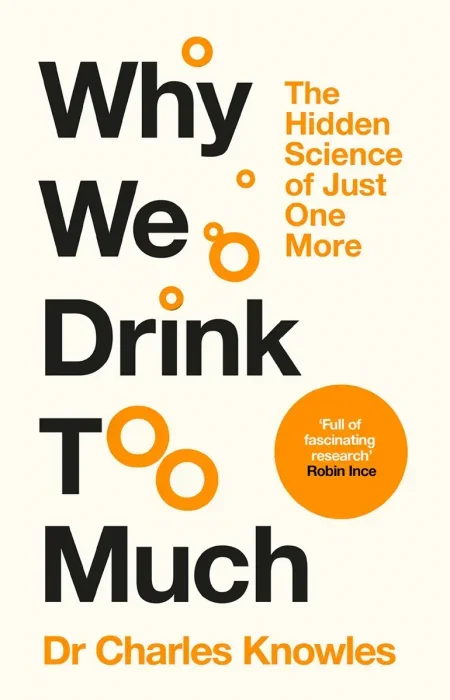
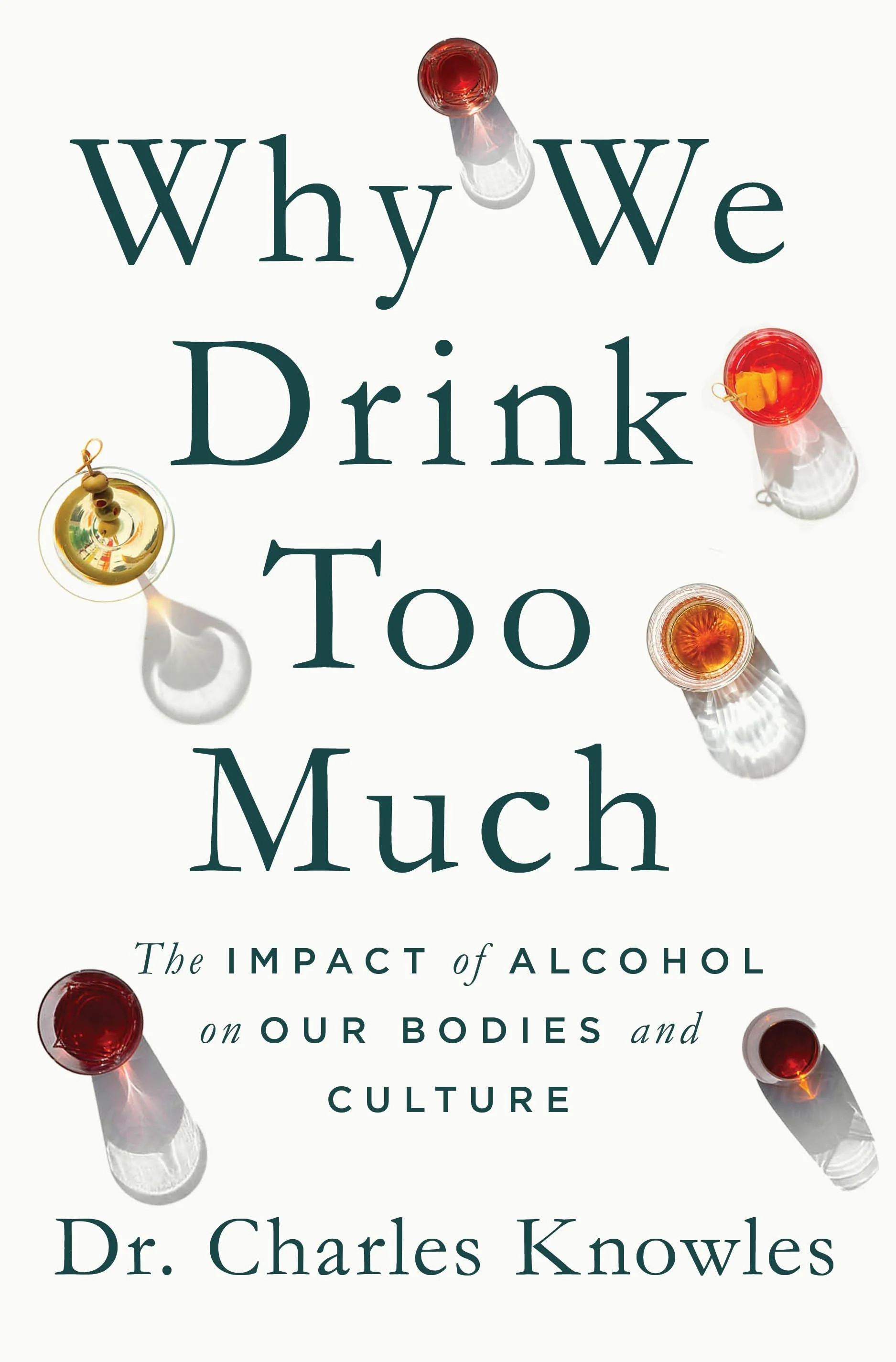
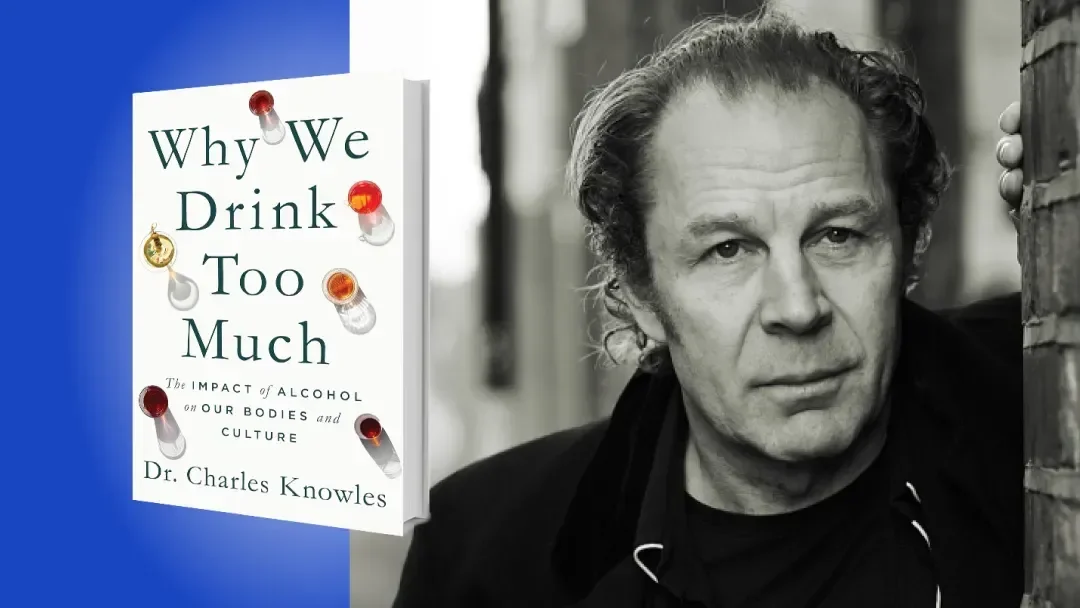
About Why We Drink Too Much by Charles Knowles
Why I Wrote it…
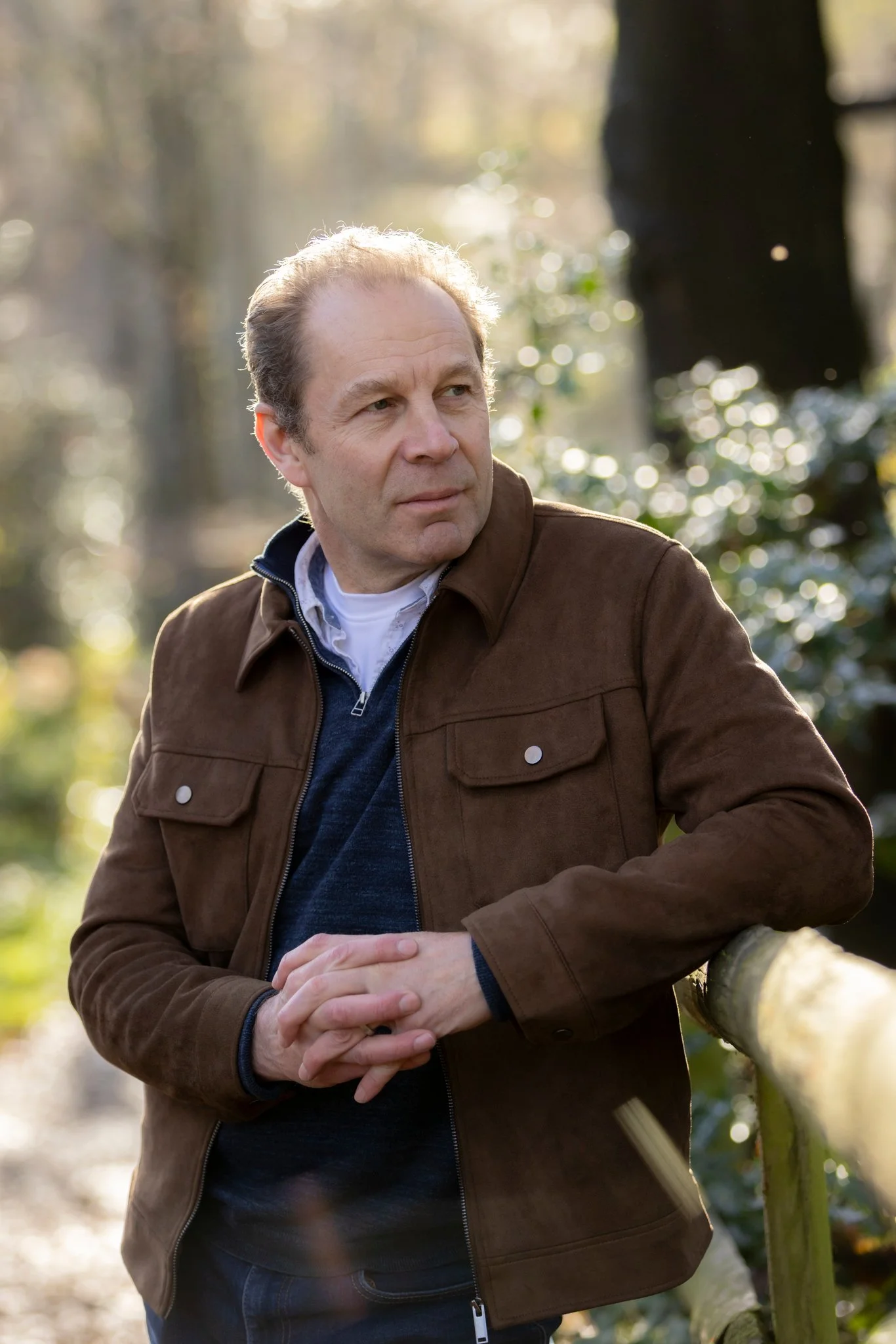
This book started out as a memoir - the crazy idea of my music producer Nick Tauber (of Thin Lizzy, Marillion). It was clear that this wasn’t going to go anywhere (I’m not that interesting). However, a couple of agents thought the alcohol-related bits were interesting. Thereafter, I realised that what I was really doing was trying to answer the “why me” question – why did I out of all my heavy drinking peers, become singled out to be an alcoholic?
On investigating further, I realised that any adequate answer to this question requires us to address why humans drink at all. I then spent about 3 years trying to find a comprehensible answer to both questions – a task that at times I deeply regretted starting.
The result is a book that avoids excessive medical jargon but does contain a lot of scientific information, especially in regard to the troublesome complexity of the brain. Where possible, it uses examples, analogies, and some of my own experiences to illustrate certain themes.
I’m not sure that there is another book like it – at least not one I have found that combines my own experience with the science.
How It Can Help You
The book is not anti-alcohol. It provides a balanced view of the role that alcohol has in our lives with several new concepts in how we choose to drink and how such freedom of choice may become eroded. It tackles the science of how addiction develops and the evidence for nature and nurture as risk factors for problematic drinking.
Importantly, the book does not just focus on the sharp end. I have tried to encompass the whole spectrum with a special focus on new ideas like grey area drinking. The book is therefore relevant to anyone reviewing their relationship with alcohol, whether they define as a ‘grey are drinker’ or maybe just someone who is sober curious.
Finally, it provides a blueprint for change by explaining how all commonly used approaches to stopping or moderating drinking can be distilled down to a few key scientific concepts.
My Support…
Alongside Charles Knowles’ scientific and personal exploration, Why We Drink Too Much includes the perspective of Annie Knowles, whose voice contributes an important lived-experience dimension to the narrative. Through her work as The Sober Rainbow Rider, Annie writes and speaks about recovery, resilience, and wellbeing, offering compassionate and practical reflections on navigating change in one’s relationship with alcohol. Her contribution helps balance the book’s research-led analysis with insight grounded in personal growth and real-world experience.

Online Reviews for “Why We Drink Too Much”
-
![Book cover titled "Why We Drink Too Much" by Dr. Charles Knowles, with several pills spilling out of a pill bottle illustration. Black and white photo of a man with wavy hair leaning against a brick wall.]()
The Big Idea Book Club
Why We Drink Too Much by Charles Knowles explores why alcohol is so deeply woven into our lives by looking at its biological, psychological and cultural roots. Drawing on neuroscience and biology, Knowles explains how alcohol affects the brain’s reward systems and why drinking patterns vary so widely, challenging simplistic views of problematic drinking and inviting readers to rethink their own relationship with alcohol
-
![A collection of vintage glassware and pottery, including a tall textured glass, ornate goblet, castle-shaped mug, mug with floral design, small pitcher, and other decorative vessels.]()
Literary Hub
Alcohol is often framed as the world’s oldest and most widely used recreational drug, deeply embedded in human culture and social life across centuries. The Lit Hub piece explores how drinking is tied not only to pleasure and ritual but to history, identity, and behaviour, highlighting alcohol’s long-standing role in shaping social norms and shared experiences while also acknowledging the tensions between its cultural acceptance and its potential harms.
-
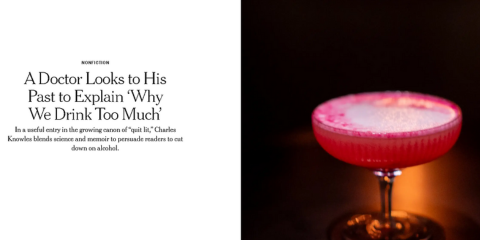
![A book opened to a page with the title "A Doctor Looks to His Past to Explain 'Why We Drink Too Much'" and a cocktail glass with a pink drink on a dark background.]()
New York Times (subscription required)
Charles Knowles’ journey from damaging drinking experiences to long-term sobriety while unpacking the biological and cultural forces behind alcohol use. It highlights the book’s mix of stark lived anecdotes, accessible neuroscience and reflections on social history, suggesting that while the scientific detail can be dense, the human narrative and broader insights into dependence, memory and health risks make the work both grounding and persuasive — encouraging readers to confront alcohol’s role in their own lives.
-
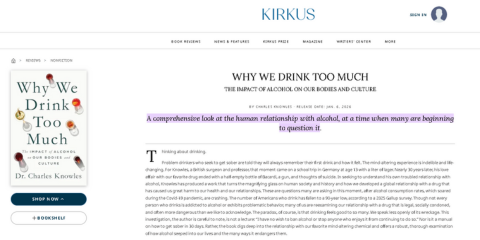
![A webpage from Kirkus Reviews titled "Why We Drink Too Much" discussing alcohol consumption and its effects on bodies and culture.]()
Kirkus Reviews
Kirkus Reviews describes Why We Drink Too Much as a personal yet wide-ranging exploration of humanity’s relationship with alcohol, combining Charles Knowles’ experiences with broader social and historical insight. The review emphasises the book’s balanced, non-judgemental approach, presenting it as a timely examination of alcohol’s cultural acceptance and risks as more people reconsider their drinking.
-
![Two glasses of red wine on a table with a blurred background.]()
New Scientist (subscription required)
It’s January, which means I am slogging through Dry January after the festive overindulgence. This year, however, I am doing so with a book in hand: Charles Knowles’s Why We Drink Too Much, a guide not only to why we drink, but also to what happens in our bodies and brains when we do…..

PREFACE
A SUNNY AFTERNOON IN FLORIDA
It is an undefined time in the afternoon. I am sitting beside a garden table on the wooden decking behind Willie’s house. The weather is warm: A giant mango tree frames a garden of tropical flowering plants. I am alone; to be precise, I have been left alone. Left by my family, Willie, and Chad to recover from the hangover of the night before. But I am not recovering. I have on the table a half-empty bottle of Bacardi and a handgun. I consider taking my own life; it is not the first time. The following day, now almost ten years ago, my thirty-year relationship with alcohol ended. This book is inspired by my journey and other people like me.
On the face of it I am a success: a professor and surgeon, a husband and father, a Lincolnshire school boy who surpassed all expectations to become a Cambridge graduate. Along the way I have variously been a competitive runner, a boxer, and an army reservist. I am also a musician and singer-songwriter. But perhaps what now defines me most is that I am a recovering alcoholic. Each of us in our mind’s eye has some sort of idea of what an alcoholic looks like, but I am guessing that a professor of surgery is not a common stereotype. Rather, we tend to think of alcohol dependence as something that only happens to other people - poor people from disadvantaged backgrounds and broken homes, people who have weak will power and lack moral integrity. But actually, I have come to realise that I am exactly the sort of person to be an alcoholic.
WHY DO WE DRINK?
Have you ever thought about why we drink? What is it that makes humans so attracted to alcohol? Because one thing is certain—we do like alcohol. Alcohol is the world’s longest serving and most popular drug. Our human ancestors evolved to metabolise it over ten million years ago and we have been deliberately manufacturing it for over ten thousand years.
In consuming alcohol, we are not alone. From rodents to apes, we have many kindred spirits when it comes to the drink. This is because drinking alcohol can be fun. The psychostimulant and relaxant effects of alcohol mediated by changes in chemical pathways in the brain are fundamentally pleasurable. These effects can enhance how we feel and behave and allow us to temporarily forget the troubles in our lives. We must acknowledge this—we simply cannot write it off solely as a poison and a depressant. How could drinking ever be so popular if it didn’t feel good? There is no trillion-dollar industry in grape juice. Unlike that of most other popular drugs, the consumption of alcohol is a legal pastime that is engrained in many cultures and promoted by its widespread availability. Compared to drugs like heroin and nicotine, most drinkers are not addicted to alcohol. Although regular excessive consumption may be an individual and public health issue, many people can just take it or leave it. By comparison, a small proportion of people like me may progress to a point where alcohol threatens to take their lives.
-
Explaining such differences in our human relationship with alcohol is not straightforward. It requires the synthesis of information from many scientific disciplines, including medicine, neuroscience, psychology, genetics, epidemiology, sociology, and even anthropology. Moreover, any explanation must satisfy an acid test—does it fit with the lived experience of someone who is either coming to worry about their drinking and their ability to control it, or someone who is dependent? Ultimately, many problems with alcohol derive from an erosion of choice caused by changes in our brain. These changes result from the way we process reward and how we remember such experiences. For some of us, the effect of alcohol on our psyche is just not the same as for other people—we feel more reward from it, and we more deeply memorise the experience. Such variation stems partly from genetics but greatly from what the world throws at us, especially during our childhoods.
I am a senior academic at a major UK university who has published over three hundred peer-reviewed scientific papers and several other books. While many of these papers concern aspects of neuroscience which align with my interest in bowel disease, I am not a trained expert in any health discipline pertaining to alcohol. However, my lack of formal qualification has enabled me to cast a fresh pair of eyes on a very challenging subject without being professionally siloed. In so doing, I have applied the scientific rigour I would apply to any subject in my own field, but also the personal experience gained only by seeing the problem first hand in myself and many others.
I started writing this book to answer the “why me?” question for myself, one that seems to be almost uniformly swerved by other books. I also realised that there was a need to close the gap between the content of abundantly available memoirs, quit-lit, self-help books, and the detailed information found in several medical textbooks. The result, I hope, is a book that avoids excessive medical jargon but does contain a lot of scientific information, especially in regard to the troublesome complexity of the brain. Where possible, I have used examples, analogies, and some of my own experiences to illustrate certain themes. My wife, Annie, has also added some further perspective on my story.
I have tried at all times to carefully separate my opinion from what we know with a level of certainty. The text is scientifically referenced for the interested reader with selected citations taken, where possible, from top scientific journals such as the Lancet and Nature. It also covers the relevant historical scientific discoveries that underpin the study of any complex disease.
Although I never drank at or before work, in telling my own story I have applied a level of honesty that some people may find troubling for a practicing surgeon. This is deliberate on my part. A great deal of the societal problems with alcohol stem from ongoing prejudice. When I eventually got sober, I asked the question that if the very people tasked with providing healthcare couldn’t lead in coming clean about their own problems, what hope did everyone else have? In this I am in good company. One of the two original founders of Alcoholics Anonymous, “Dr. Bob,” also was a proctologist. After so much progress in destigmatising other areas of mental health, why do people addicted to alcohol have to remain anonymous?
WHY NOW?
This book is timely. Many people are now starting to re-evaluate their relationship with alcohol. The domain previously occupied only by health providers and organisations like Alcoholics Anonymous has now expanded to include hundreds of alcohol-free, sober curious, and grey area drinking communities. Health experts and celebrities with alcohol problems fill our media, extolling the virtues of a life without alcohol or berating governments for their failure to recognise and act on what they see as the epidemic of alcohol-related harm in society.
In parallel, alcohol-free drinks have evolved from a couple of undrinkable lagers that were the preserve of designated drivers to an industry that is growing faster than its alcohol-filled counterpart. There are now dry bars, clubs, and shops that retail only alcohol-free products. Compared to my generation, a higher proportion of our younger generation are choosing not to drink at all.
AND FINALLY . . .
I am not a zealot about alcohol. I still go to the pub with friends, and I have no wish to ban alcohol or stop anyone who enjoys it from continuing to do so. This book is not a manual for “getting sober in thirty days” (or any other time interval for that matter). It does, however, in a final section, provide a blueprint based on the science for anyone who might want to review their relationship with alcohol. For people like me, who have visited the edge and not enjoyed the view, I hope that it provides a satisfactory answer to the “why me?” question. For everyone else, it may serve to dispel the misguided beliefs we have about alcohol dependency and encourage a little gratitude that (for now at least) it isn’t you.
Where to buy
DIGITAL/PHYSICAL COPIES
Amazon - Blackwells - Goodreads - Waterstones - Foyles - Google Books - The Guardian Bookshop
AUDIOBOOKS: